Titel: Wollust
Entstehungsjahr: 2017
Maße: Bügelweite: 30 x 27 cm
Gewicht: 2,3 kg
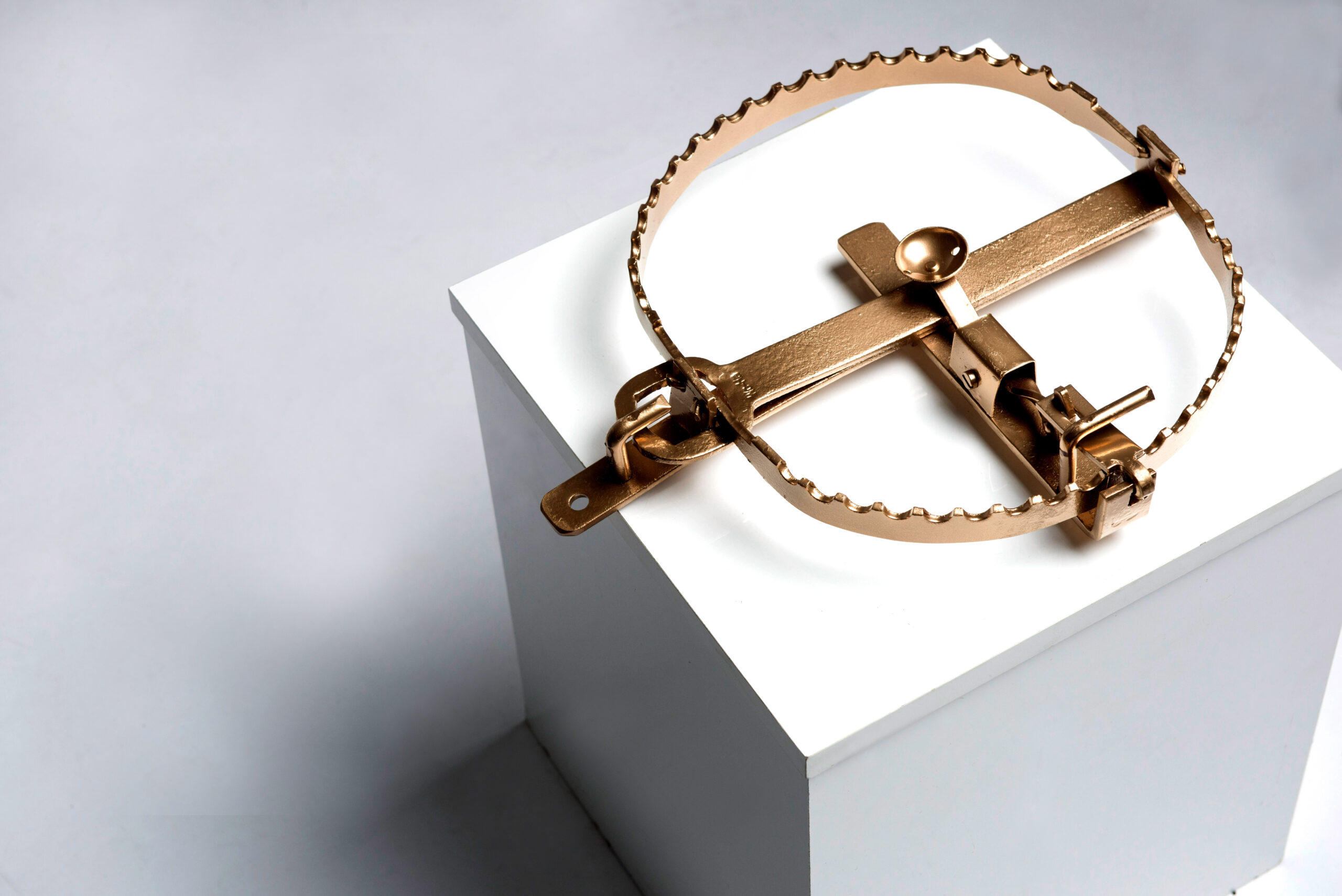
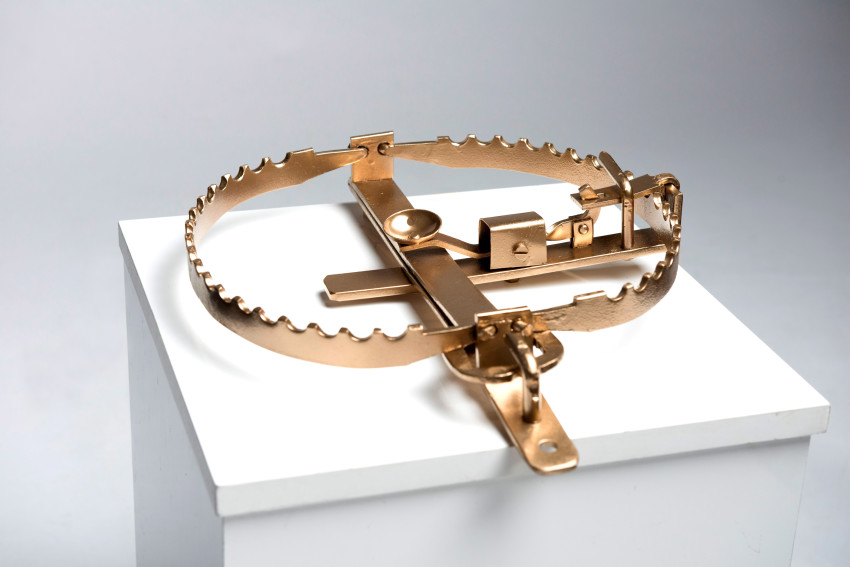
Material: Vergoldete Schlagfalle/Fanggerät, Marderselbstabzugeisen
Wollust
Materialästhetik und funktionale Gewalt. Das Werk „Wollust“, gezeigt im Rahmen der Ausstellung „Luxuria“ (2017), basiert auf der Transformation eines funktionalen Objekts: einer Schlagfalle. Durch die Vergoldung wird ein Instrument, das ursprünglich für das Töten von Tieren konzipiert ist, in einen ästhetisch aufgeladenen Kontext überführt.Die formale Aufwertung durch Gold erzeugt eine visuelle Ambivalenz. Einerseits verweist das Material auf Wert, Begehrlichkeit und kulturell codierte Luxusvorstellungen. Andererseits bleibt die zugrunde liegende Funktion der Falle unverändert: ein mechanisches System zur abrupten und endgültigen Beendigung von Leben. Diese Spannung zwischen ästhetischer Aufwertung und inhärenter Gewalt bildet den zentralen Diskurs des Werkes.
Verführung als Wahrnehmungsstrategie
Auffällig ist das Fehlen eines klassischen Köders im Zentrum der Falle. Die Leerstelle verschiebt die Aufmerksamkeit auf die Oberfläche selbst. Die Vergoldung übernimmt die Rolle des Lockmittels und adressiert unmittelbar die Wahrnehmung des Betrachters. Attraktion entsteht hier nicht durch inhaltliche Substanz, sondern durch visuelle Codierung von Wert.
Im Kontext von „Luxuria“ lässt sich „Wollust“ als Untersuchung zeitgenössischer Mechanismen von Verführung lesen. Das Werk thematisiert, wie Oberflächenästhetik als Träger von Versprechen fungiert, während potenziell destruktive Strukturen unsichtbar bleiben oder ausgeblendet werden. Die Falle wird damit zur Metapher für Systeme, die auf Anziehung und gleichzeitiger Gefährdung basieren.Die Arbeit operiert weniger über moralische Bewertung als über Irritation. Sie fordert eine kritische Auseinandersetzung mit Wahrnehmungsgewohnheiten und stellt die Frage, inwieweit Wertzuschreibungen an äußere Erscheinung gebunden sind. Der Moment der Erkenntnis entsteht nicht durch physische Erfahrung, sondern durch kognitive Verschiebung.
„Wollust“ kann somit als Reflexionsraum verstanden werden, in dem sich ästhetische Verführung, funktionale Realität und kulturelle Projektion überlagern.
Title: Lust
Year of Creation: 2017
Dimensions: Jaw span: 11.81 × 10.63 in
Weight: 5.07 lb
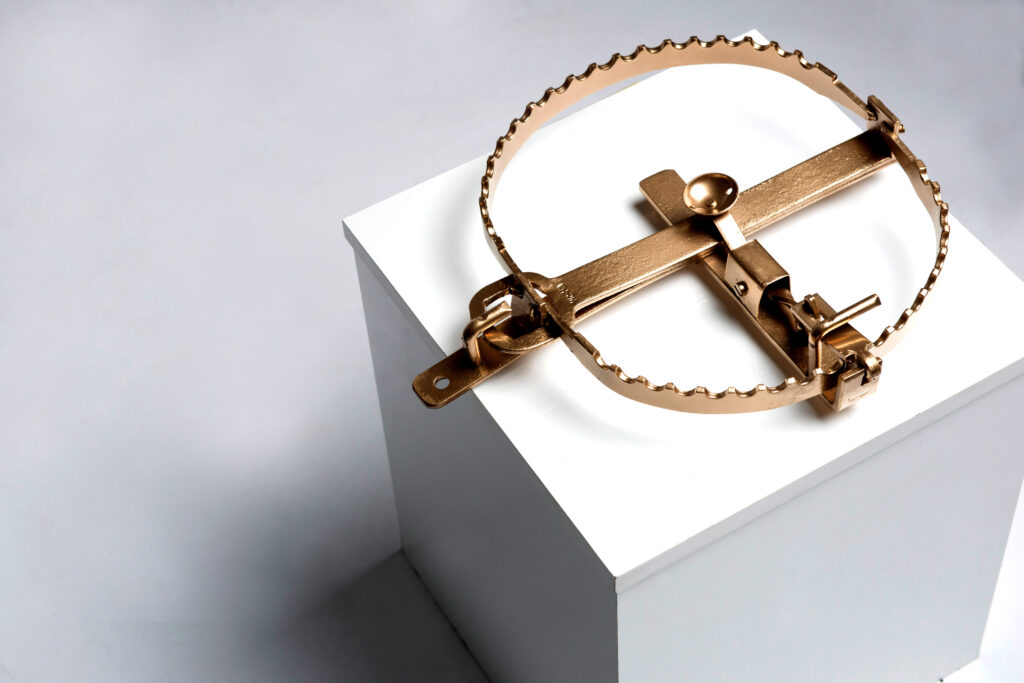
Material: Gilded snap trap/catching device, self-triggering marten trap
Lust
Material Aesthetics and Functional Violence. The work “Wollust,” was created for the exhibition “Luxuria” (2017), it is based on the transformation of a functional object: a snap trap. Through gilding, an instrument originally designed for killing animals is transferred into an aesthetically charged context. The formal enhancement through gold creates a visual ambivalence. On the one hand, the material points to value, desirability, and culturally coded notions of luxury. On the other hand, the underlying function of the trap remains unchanged: a mechanical system for the abrupt and definitive termination of life. This tension between aesthetic elevation and inherent violence forms the central discourse of the work.
Seduction as a Strategy of Perception
.
Notably, the absence of a traditional bait at the center of the trap shifts attention to the surface itself. The gilding assumes the role of the lure and directly addresses the viewer’s perception. Attraction here emerges not through substantive content, but through the visual coding of value.
Within the context of “Luxuria,” “Wollust” can be read as an investigation of contemporary mechanisms of seduction. The work addresses how surface aesthetics function as carriers of promise, while potentially destructive structures remain invisible or are actively obscured. The trap thus becomes a metaphor for systems based on attraction and simultaneous threat. The work operates less through moral judgment than through irritation. It calls for a critical engagement with habitual modes of perception and raises the question of the extent to which attributions of value are bound to outward appearance. The moment of realization does not arise through physical experience, but through a cognitive shift.
“Wollust” can therefore be understood as a space of reflection in which aesthetic seduction, functional reality, and cultural projection overlap.